Industry Updates & Introducing UTDA's Audition Analytics
There have been some developments in our industry over the past few weeks that I think are worth paying attention to.
California recently strengthened its film and television production incentives, and a new bipartisan bill introduced in Congress would create a 20% federal tax credit for qualifying film and television productions in the U.S. At the same time, the Paramount/Warner Bros. merger officially closed this week, with commitments to significantly increase domestic film and television production.
None of this means that the challenges actors have experienced over the past few years are suddenly behind us. But after so much conversation about declining production and work moving elsewhere, I think it's significant that we're seeing serious efforts—at both the state and federal level—to make producing film and television in the U.S. more competitive.
I've been thinking a lot about this because the industry actors are navigating today is very different from the one we were navigating even five years ago. There are opportunities, but where those opportunities are coming from, how actors are accessing them, and what is actually moving their individual careers forward isn't always obvious.
That was a big part of the conversation in our How to Get More Film, TV & Theatre Auditions — With or Without an Agent workshop a few weeks ago. I was thrilled with how many actors joined us, but even more with the conversation itself. We weren't simply talking about how to get another audition. We were talking about how to understand what's actually working in your career so you can make better decisions about what to do next.
And that brings me to something I'm particularly excited to share: Audition Analytics is now live in Up-To-Date Actor.
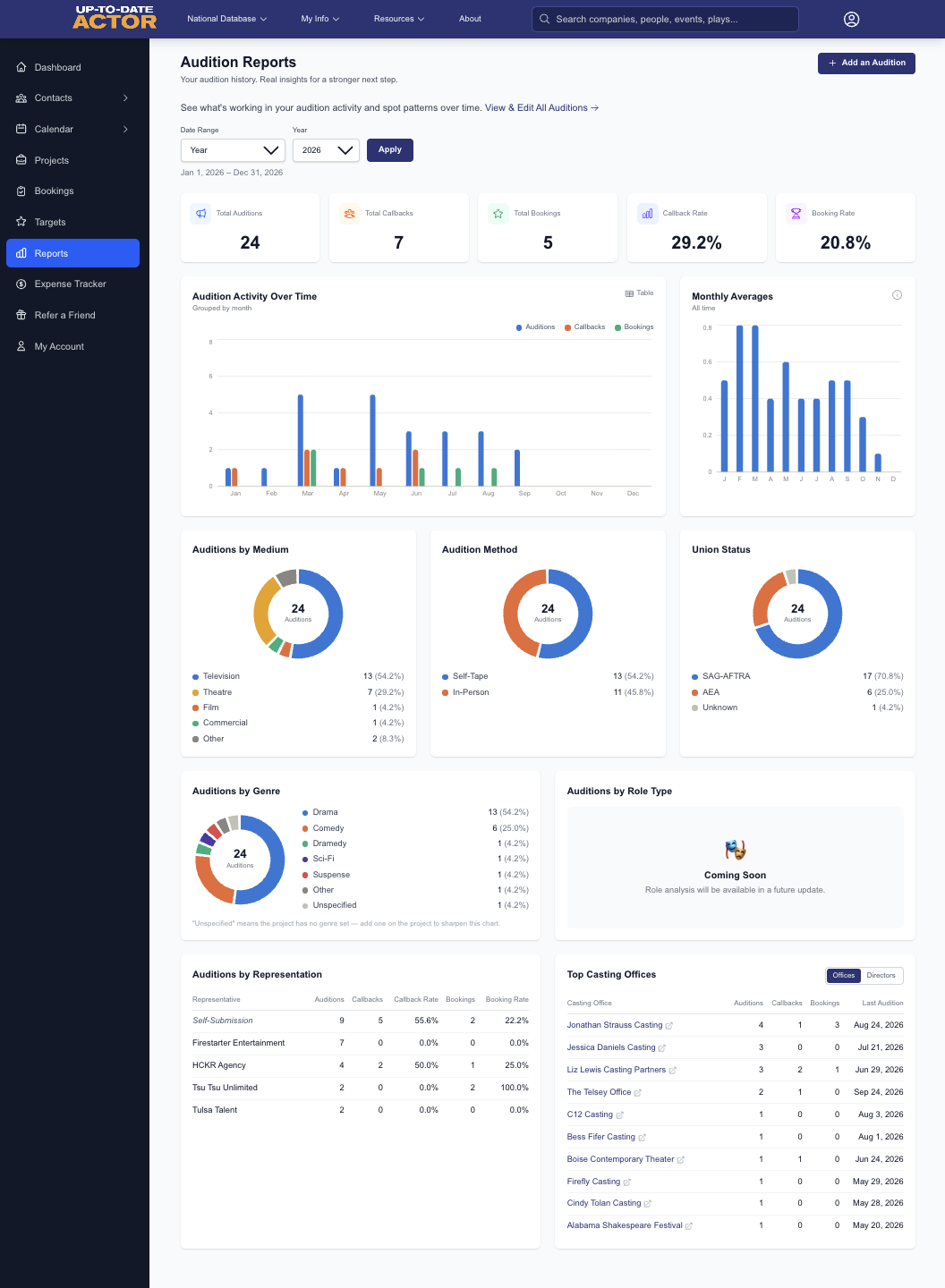
This is a feature our members have been asking us to build for some time. If you already track your auditions in UTDA, you can now see the larger patterns behind that history—where your auditions are coming from, how your activity is changing over time, which casting offices you're seeing, where callbacks and bookings are happening, and more.
Longtime UTDA members may already have years of audition history in their accounts, which means you don't need to enter anything new before this becomes useful.
For me, that's the larger purpose behind features like this. The industry is going to keep changing. We can't control all of those changes, but we can get better at understanding what's happening in our own careers and use that information to decide where to put our time and energy next.
And sometimes the data points you toward the next question. Once you've identified the casting offices that are important to your career—or the ones you want to be working with—how do you actually get on their radar and stay there?
That's something Annie and I are going to dig into in our next free workshop on November 5th at 3 PM ET, Stay on Their Radar: How to Get Casting Directors to Know & Remember You. We'll be talking about practical, professional ways to build and maintain relationships with casting directors without feeling like you're constantly trying to “sell” yourself.
And if you missed our September workshop, the replay is also available here. We go much deeper into how to look at your audition history, identify patterns, and use that information to help shape your career strategy.
Wishing you the best with your performance career!
 ~Abigail Hardin
Founder, Up-To-Date Actor