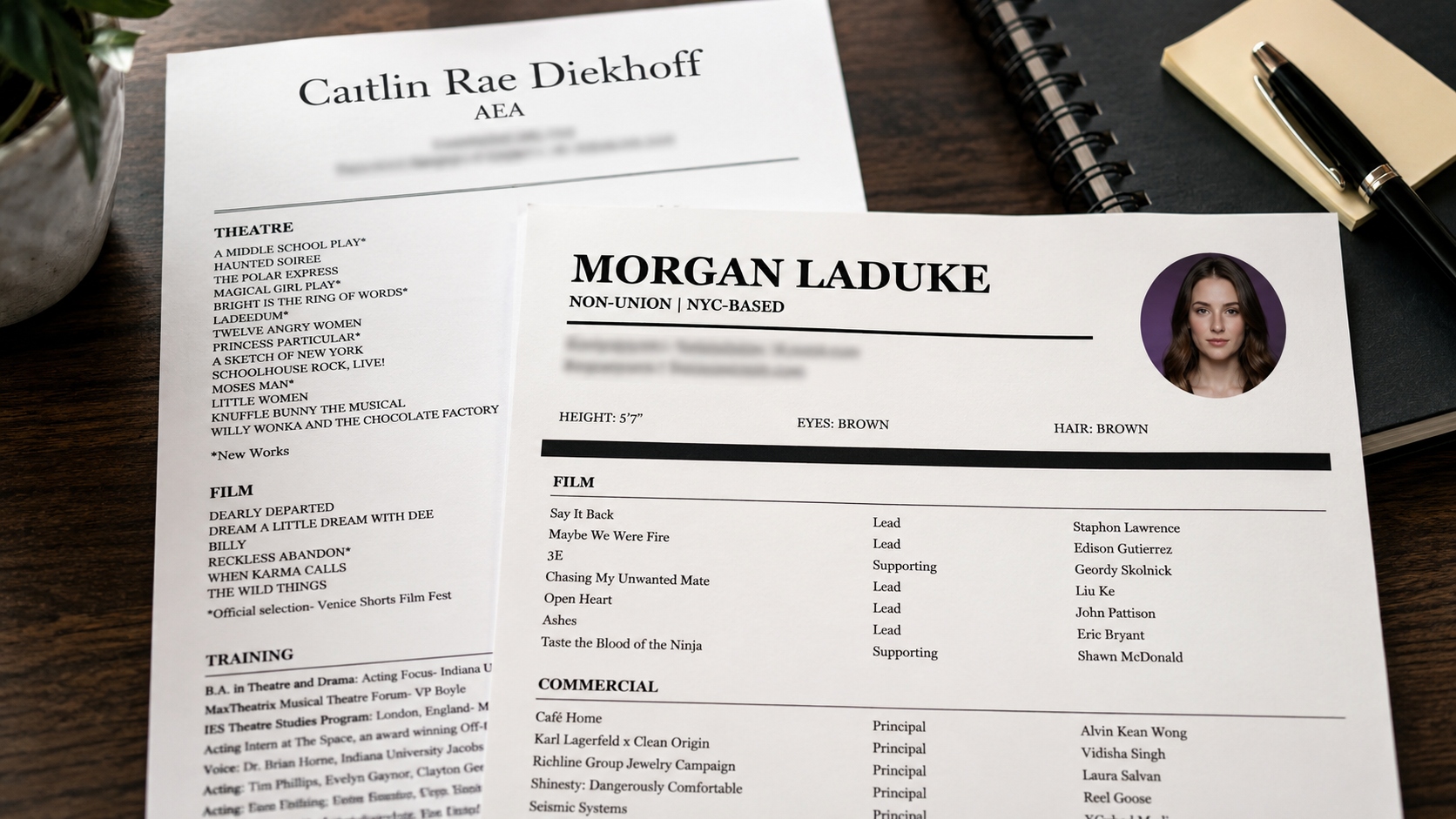
Resume Update: Industry Standards That Still Matter (and Why They Affect Your Submissions)
When we first published Formatting Your Acting Resume: How to Present Your Work Like a Pro, our goal was to help actors create resumes that looked clean, professional, and easy for industry professionals to read.
Unfortunately, we're still seeing one issue come up over and over again: actors are formatting credits using terminology that doesn't reflect industry standards.
While some people dismiss resume formatting as "just a matter of opinion," it really isn't. Your resume is one of the first things an agent, casting director, producer, or director sees. If the terminology is inaccurate, it can signal that the actor either hasn't been properly guided or doesn't yet understand how the industry classifies roles.
No one is going to refuse to cast you because you wrote "Supporting" instead of "Co-Star." But details matter. Your resume should demonstrate that you understand the business you're trying to work in.
Your Resume Is a Marketing Tool—Not a Complete History
One of the biggest misconceptions we encounter is the belief that an acting resume should include every booking you've ever had.
It shouldn't.
Your resume is not a career archive—it's a marketing tool. Think of it as a carefully curated snapshot of your professional experience. Every credit should help communicate how casting should see you and where you fit in today's marketplace.
The goal isn't to impress someone with the longest list of credits possible. It's to present the strongest, most relevant overview of your work in a way that supports the area of the industry you're currently pursuing.
Whether your focus is television, film, theatre, commercials, or voiceover, your resume should highlight the credits that best reinforce that objective. Not every booking belongs on every version of your resume, and as your career develops, some credits that once served you may no longer need to be there.
A focused resume is almost always stronger than an exhaustive one.
Film and Television Credits Are Not the Same
One of the most common mistakes we continue to see is actors using film credit terminology for television projects—or vice versa. These terms aren't interchangeable.
For decades, SAG and AFTRA credited performers differently in their contracts. Even after merging into SAG-AFTRA, those distinctions have continued to shape the terminology used for professional film and television credits.
Television Credit Categories
Series Regular
A lead character who appears in the main title sequence and promotional materials.
Recurring
A character who appears across multiple episodes but is not a series regular.
Guest Star
A significant supporting role within an episode. Guest stars often have multiple scenes, a character arc, and may appear in the opening credits. Think of the killer on a crime procedural or the guest patient on a medical drama.
Co-Star
A smaller supporting role that typically appears in one or two scenes. Co-stars often have dialogue, although non-speaking co-star roles do occasionally exist.
Examples include:
- Police Officer
- Bank Teller
- Waiter
- Teacher
- Receptionist
Featured
A featured background performer with no dialogue who is visually highlighted.
Film Credit Categories
Film roles are categorized differently.
Lead
The central character of the film.
Supporting Lead
An important character with substantial screen time who helps carry the story alongside the lead.
Supporting
A character who advances the story but has less overall involvement than the lead or supporting lead.
Featured
A featured background performer with no dialogue.
Unlike television, films do not use Guest Star or Co-Star terminology. If you're moving between film and television work, make sure the terminology on your resume reflects the type of project.
Soap Opera Credits Have Their Own Standards
Soap operas follow a different crediting system as well.
Contract
A series regular under contract.
Day Player
Comparable to a television Guest Star.
Under 5
A role with fewer than five lines of dialogue.
Featured
Featured background with no dialogue.
Commercial Credits: Keep It Simple
Commercial resumes are another area where we frequently see incorrect terminology. Professional commercial credits generally fall into only two categories.
Principal
If you were hired as a principal performer—whether you had dialogue or not—you list the role as Principal.
This includes:
- Speaking principal roles
- Non-speaking principal roles
- Voice-over principal bookings
Background
Background work generally should not appear on a professional acting resume. Even if you were featured background, union background, or clearly visible on camera, it is still considered background work.
The term Featured Background is a casting designation, not a resume credit. Likewise, On-Camera Principal (OCP) is a contract/pay category rather than something that belongs on your resume.
What About Commercial "Supporting" Roles?
There aren't any.
Avoid using:
- Lead
- Supporting
- Guest Star
- Co-Star
- Featured
Those classifications belong to other areas of the industry and shouldn't be carried over simply because they seem to describe the size of your commercial role.
Instead, simply list:
Principal
Many established actors don't even list individual commercial brands because of conflict concerns. Instead, you'll often see:
Commercials
Principal for (network - if you have booked this level) various usages. Conflicts Available Upon Request.
This is completely acceptable and widely used.
Theatre Credits Are Different Too
Another trend we've noticed is actors labeling theatre roles as Lead or Supporting. While those terms may feel intuitive, they are generally not how professional theatre credits are presented.
In professional theatre, your resume should simply list the role you played. There is no need to classify your performance as Lead, Supporting, Guest Star, or Co-Star. Those distinctions aren't part of standard theatre resume formatting.
Your character name tells the story.
Leave the Dates Off Your Resume
Another common mistake is including the year of each production.
Professional acting resumes generally do not include dates. The resume is meant to represent your body of work rather than create a timeline.
Listing dates can unintentionally draw attention to things that don't matter, including:
- Gaps in your career
- Older credits appearing outdated
- Unnecessary questions about when projects were filmed versus released
Casting directors care what you've done, not whether it happened in 2017 or 2025. Unless you're preparing a resume for a very specific academic or international purpose, leave the dates off.
Your Resume Is a Professional Marketing Document
An acting resume isn't meant to document every role you've ever booked. It's a carefully selected overview of your professional experience that communicates your strengths, your casting, and where you fit within the industry today.
Every credit earns its place because it helps tell your story as an actor. As your career develops, that may mean removing older, less relevant work to make room for credits that better represent where you are now.
Using the correct industry terminology also tells agents, managers, casting directors, producers, and directors that you understand the business and know how professional actors present themselves.
Small details won't book the job for you.
But consistently presenting yourself professionally—from your headshot to your resume to your submission emails—builds confidence before you ever step into the audition room.
At Up-To-Date Actor, we believe your talent deserves to be represented accurately. Taking the time to format and curate your resume according to industry standards helps make sure your materials give the industry a clear, current picture of who you are and the work you're pursuing.
Common Resume Mistakes We Still See Every Week
Before sending out your next submission, take a moment to review your resume for these common issues:
- Using Lead or Supporting for television credits instead of Series Regular, Recurring, Guest Star, or Co-Star
- Using Guest Star or Co-Star for film credits instead of Lead, Supporting Lead, or Supporting
- Labeling theatre credits as Lead or Supporting instead of simply listing the character name
- Listing background, featured background, or union background work on a professional resume
- Using film, television, theatre, and commercial credit terminology interchangeably
- Including production dates (professional acting resumes generally do not include dates)
- Listing every booking instead of curating the credits that best support your current casting and career goals
- Crowding your resume with outdated, irrelevant, or student work that no longer reflects your current professional level
- Forgetting that your resume is a marketing document, not a complete history of your acting career
Before you hit "submit," ask yourself one simple question:
"Does every credit on my resume help tell casting professionals who I am today and support the type of work I'm pursuing?"
If the answer is no, it may be time to refine your resume.
Remember, your resume doesn't need to tell the story of everything you've done. It needs to give the person reading it a clear picture of who you are now and why they should consider bringing you into the audition room for what you'll do next.