
What Your Audition History Can Tell You About Your Acting Career
“I need more auditions” can describe many different situations.
Maybe you really aren't finding or pursuing enough appropriate opportunities. Maybe you're submitting regularly but rarely getting called in. Maybe you are auditioning, but those auditions aren't leading to callbacks or further consideration. Or maybe you've had callbacks, final callbacks, and pins, but haven't booked recently.
Those situations can feel similar when you're frustrated with the amount of work you're getting. They don't necessarily call for the same response.
This is one reason it's worth keeping a record of your auditions and periodically looking at that history as a whole. You're not trying to turn your career into a math problem. You're looking for enough information to understand what is happening before you decide what needs your attention.
Where Is Your Audition Pipeline Working?
In our recent workshop, How to Get More Film, TV & Theatre Auditions — With or Without an Agent, we looked at an acting career as a pipeline:
Opportunity → Submission → Audition → Callback → Booking
Watch the Replay!
Active UTDA members can watch the workshop replay here. If you're not a member, you can start a risk-free trial to access the replay and UTDA's member resources.
If you're not finding enough appropriate opportunities in the first place, you may need to expand the ways you're looking for work. If you're submitting consistently but aren't getting auditions, look at the roles you're pursuing, your materials, and what casting sees when they consider you. If you're getting auditions but rarely advancing, that's a different point in the pipeline. Your preparation, audition work, training, or self-tape execution may deserve more attention.
But if you're getting callbacks, final callbacks, pins, or repeated invitations from the same casting offices, don't ignore that information because it hasn't resulted in enough bookings yet. A booking is the result you ultimately want, but it isn't the only indication that your work is getting a response. For a broader look at the ways progress can show up before a booking, read How Do You Know If Your Acting Career Is Moving Forward?
Suppose you had 50 submissions, 20 auditions, eight callbacks, two pins, and no bookings during the period you're reviewing. Actors often evaluate their careers like this:
BOOKED = WORKING
DIDN'T BOOK = NOT WORKING
That's far too simplistic.
Shift your response from “I didn't book anything” to "something is definitely working. I need to take additional steps to book the job." That changes what you might investigate next.
Look at More Than Your Audition Count
Start with a period long enough to be meaningful for your career. If you audition frequently, the last 90 days may tell you something. If your volume is lower, six months or a year may give you a more useful picture. If you want to make this kind of review part of your regular career routine, our quarterly career review offers a broader framework for periodically evaluating what's changing.
First, look at whether your audition activity has actually changed. A month that feels unusually quiet may be fairly typical compared with your history. A stretch that you dismissed as “not much happening” may include more callbacks or repeat casting activity than you remembered.
Then look at what those auditions were actually for.
If most of your auditions are for television, while film represents a relatively small percentage, that's worth knowing. The same is true if you're getting a surprising amount of traction in comedy, musical theatre, or another genre. You may find that your in-person and self-tape activity looks different than you assumed.
None of those numbers give you an instruction. If television represents most of your auditions, the conclusion isn't automatically “focus on television.” You need context. Are you pursuing more television opportunities to begin with? Is your representation stronger in that area? Are certain casting offices repeatedly bringing you in? Are your current materials particularly effective for the kinds of television roles you're being considered for?
The useful part of the data is often the next question it gives you.
Pay Attention to Who Is Generating Your Auditions
If you have representation, it's also useful to understand which auditions are coming through each member of your team and which you're generating yourself.
You may discover that your agent is responsible for most of your audition volume while your own submissions are producing a smaller number of very targeted opportunities. Or you may realize that self-submissions are contributing far more to your audition activity than you thought.
Look at what happens after the audition too. How many of those auditions are becoming callbacks or bookings?
This information needs context, particularly because you don't necessarily see every submission a representative makes on your behalf. A callback percentage shouldn't become a grade for your agent or manager. But knowing where your auditions are coming from gives you a more useful basis for evaluating your own activity and having informed conversations with your team.
It can also challenge assumptions you've been making about your career. If you think self-submission “never works for me,” your history can tell you whether that's actually true.
Your Audition History Is Also a Casting History
This may be one of the most valuable things to track over time.
Which casting offices have brought you in repeatedly? Which individual casting directors appear again and again? When did you last audition for them? Have any of those auditions led to callbacks or bookings?
Five auditions from the same casting office mean something different from five auditions from five offices you've never encountered again. You don't need to invent a relationship that isn't there, but you do know that the first office has seen your work repeatedly.
That becomes useful information when you're researching future projects and deciding where to put your relationship-building efforts. If a casting director who has called you in several times is attached to an upcoming project that's genuinely appropriate for you, you aren't starting with the same context as you would with someone who has never seen your work.
Repeated consideration can also be easy to miss when you're focused primarily on bookings. You remember the role you didn't get. You may not immediately recognize that the same office has brought you in four times over the last year.
Be Careful With Small Samples
Rates can make career information look more conclusive than it is.
One callback from three auditions gives you a 33% callback rate. That percentage is mathematically correct. Three auditions still aren't enough information to make a major judgment about your audition technique, materials, or career direction.
The same problem comes up when you compare parts of your career. Five theatre auditions and 30 television auditions don't give you equivalent samples. Neither do three months in one medium and three years in another.
And your audition history can't tell you why every decision was made. It doesn't know who else auditioned, whether the role changed, whether someone had an existing relationship with the creative team, or whether a production changed direction after you read.
You don't need an explanation for every individual result. You're looking for patterns that repeat often enough to deserve your attention.
Find the Bottleneck, but Look for Momentum Too
When you review your career, it's natural to look for the problem first. Sometimes that's exactly what you need to find.
If you're pursuing plenty of appropriate opportunities and rarely getting auditions, there may be something worth examining in your role targeting, headshots, reel, résumé, casting profiles, or submission choices. If you're auditioning consistently but almost never advancing, you have a reason to look more closely at the audition itself and at any professional feedback you've received.
But your history can also show you what's already working.
Maybe one casting office keeps calling you in. Maybe your theatre auditions are consistently advancing. Maybe self-submissions have produced several of your strongest opportunities. Maybe you're getting regular callbacks through one representative. Those aren't reasons to stop developing the rest of your career. They're information about where you're already getting a response.
If you're regularly getting callbacks, final callbacks, or pins, be particularly careful about dismantling everything upstream simply because you haven't booked recently. Your headshots, reel, submission strategy, and audition work got you into serious consideration for those roles.
There may still be things to improve. There may also be things you should leave alone.
Seeing the Patterns in Your UTDA Audition History
This is the thinking behind the new Audition Analytics & Reporting in The Up-To-Date Actor.
If you've been using your UTDA Audition Tracker, you already have a record of what you've auditioned for and what happened. Audition Analytics gives you a way to pull back from individual entries and look across that history.
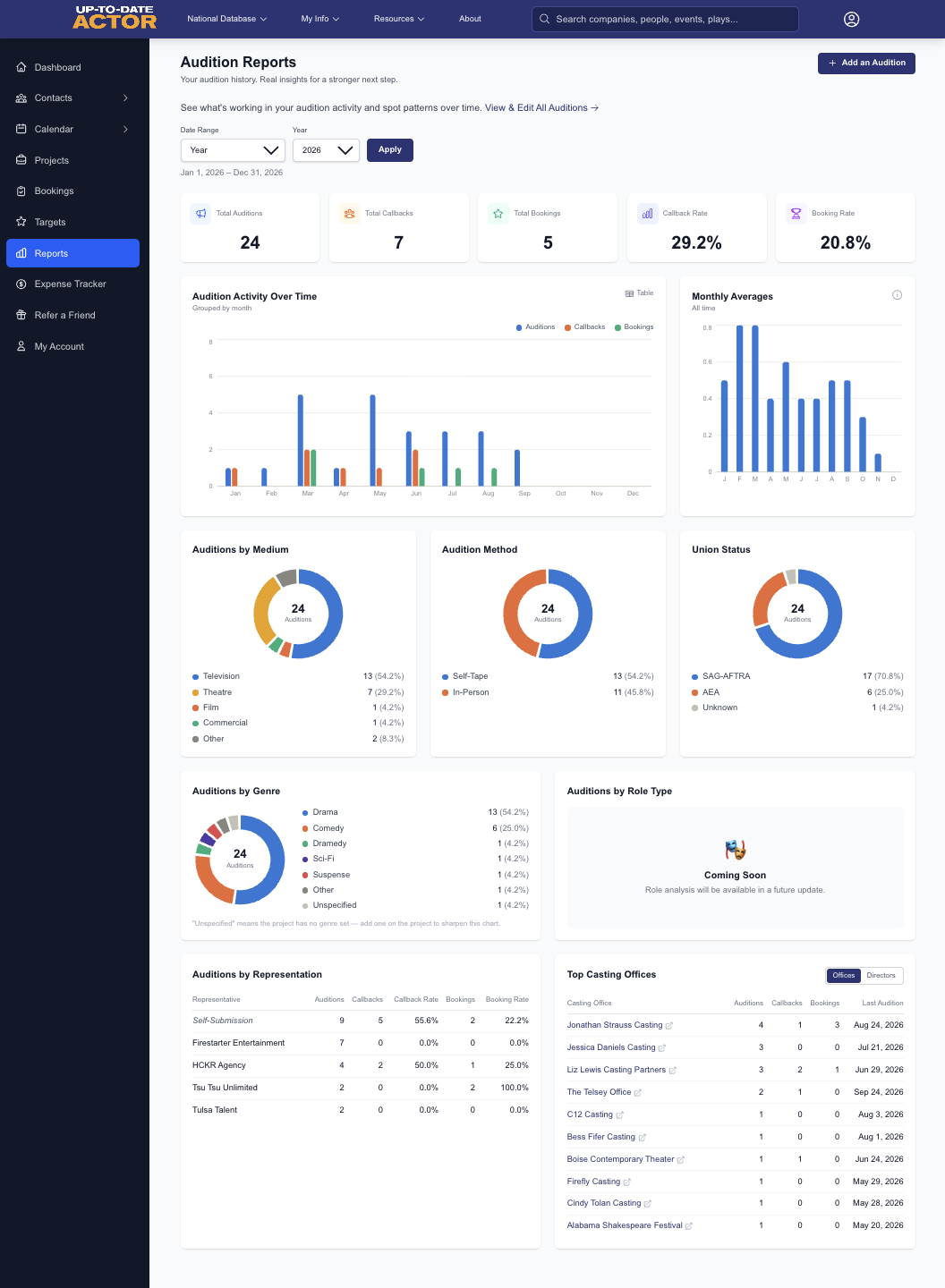
You can review the last 90 days, a month, a year, a custom period, or your full audition history. The snapshot shows your auditions, callbacks, and bookings for that period, along with your callback and booking rates. The activity chart lets you see how those numbers have moved over time.
There is also a separate Monthly Averages report based on your full history. Instead of telling you that September was simply “slow,” for example, you can see how your average audition activity in September compares with other months across the years you've tracked. Your own history is more useful here than assuming every actor should experience the same seasonal pattern.
You can also see how your auditions break down by medium and genre, as well as whether they were self-tapes or in-person auditions. If you're trying to understand what kinds of opportunities are actually making up your career, those reports give you something more concrete than memory.
The representation report looks at each representative attached to your auditions, along with self-submissions, and shows the number of auditions, callbacks, and bookings associated with each. It also calculates callback and booking rates for those auditions.
That doesn't tell you whether a representative is “good” or “bad.” It lets you see how different sources are contributing to your audition history and gives you information you can use when thinking about your own efforts or talking with your team.
And then there are your casting patterns. The reports show which casting offices and individual casting directors appear most frequently in your audition history, how many callbacks and bookings are associated with them, and when you last auditioned for them.
That report is worth spending some time with. The people who repeatedly bring you in are part of your professional history, whether or not every audition has resulted in a booking. Knowing who already knows your work can inform how you research upcoming projects, maintain professional relationships, and decide where future outreach makes sense.
Decide What Deserves Your Attention Next
You don't need to respond to an audition audit by changing five things at once.
If you've identified a genuine bottleneck, choose one thing you can work on and give yourself enough time to see whether it changes anything. If you've identified an area where you're already getting traction, consider how you can create more appropriate opportunities in that area without abandoning everything else.
Then keep tracking what happens.
Your audition history can't tell you why you didn't book a particular role, and it can't predict the outcome of the next one. What it can do is make it harder for one bad week, one exciting callback, or a vague feeling that “nothing is happening” to become your entire assessment of your career.
Sometimes the most useful thing the numbers can give you isn't an answer. It's a better idea of what you should be paying attention to.