Blog
Tips, insights, and resources for actors navigating the entertainment industry
Showing 12 of 258 blog posts

What Is a Specific General Submission—and How Do You Create One?
You find a film or television project that feels like a particularly good fit for you. Maybe it's a new series shooting in your market, a feature with a world you fit naturally into, or an established show that regularly casts roles in your wheelhouse.
You research the project. You know who's casting it. But there isn't a public breakdown with a specific role for you.
This is where a Specific General Submission can come in.
“Specific General Submission” is a term we use at Up-To-Date Actor for a targeted introduction to a casting office tied to a specific project, without necessarily submitting for a known, publicly available role.
It is specific because you have researched the project and have a legitimate reason to believe you could fit within its casting world. It is general because you aren't necessarily saying, “Please consider me for the role of Sarah.” You may not even know what roles are currently being cast. You're introducing yourself for appropriate opportunities within that project and giving casting useful information about where you might fit.

How to Research a Project Before You Submit or Audition
Most of the time, project research begins when you get an audition. You look up the series, film, theatre, director, or casting office because you suddenly have a reason to know more about them. Sometimes that research starts a little earlier, when you see a breakdown and are deciding whether to submit. But in both cases, the project has already found its way to you.
There is another habit worth developing: regularly learning what is being developed, announced, cast, and produced in the areas of the industry where you want to work. You don't need an audition to have a reason to know that a television series is gearing up for another season, a theatre has announced its upcoming season, or a production company is developing a new film.
Knowing what's happening gives you a better understanding of where the work is being created and who is creating it. It can also help you recognize an opportunity before an audition ever arrives.

What Your Audition History Can Tell You About Your Acting Career
“I need more auditions” can describe many different situations.
Maybe you really aren't finding or pursuing enough appropriate opportunities. Maybe you're submitting regularly but rarely getting called in. Maybe you are auditioning, but those auditions aren't leading to callbacks or further consideration. Or maybe you've had callbacks, final callbacks, and pins, but haven't booked recently.
Those situations can feel similar when you're frustrated with the amount of work you're getting. They don't necessarily call for the same response.
This is one reason it's worth keeping a record of your auditions and periodically looking at that history as a whole. You're not trying to turn your career into a math problem. You're looking for enough information to understand what is happening before you decide what needs your attention.

The Acting Career Tool You Might Be Overlooking: A Great Coach
You can spend years training as an actor without anyone really explaining where an audition coach fits into your professional career. You know you should take classes and continue developing your craft. But when should you work privately with a coach? Is coaching primarily for actors who are still learning how to audition? And as you become more experienced, should you need one less?
A great coach serves a different purpose than a great class. Knowing when to bring in that outside perspective—and when to trust your own preparation—is part of developing a professional audition process.

How Do You Know If Your Acting Career Is Moving Forward?
There are stretches in an acting career when progress is easy to see. You book a role. You sign with a new agent. You get called back for a casting office you've been hoping to work with. You finally have the footage you needed for your reel.
Then there are the stretches when you're doing a lot, but you're not quite sure whether any of it is working.
Maybe you're auditioning regularly but haven't booked in a while. Maybe you've been submitting, taking class, updating your materials, and building industry relationships without a major result to point to. Or maybe things have been quieter than you'd like, and you're starting to wonder whether your career has stalled.
If bookings are your primary measurement of progress, you can spend months doing productive work and still feel as though nothing is happening.
So it helps to know what else to look for.
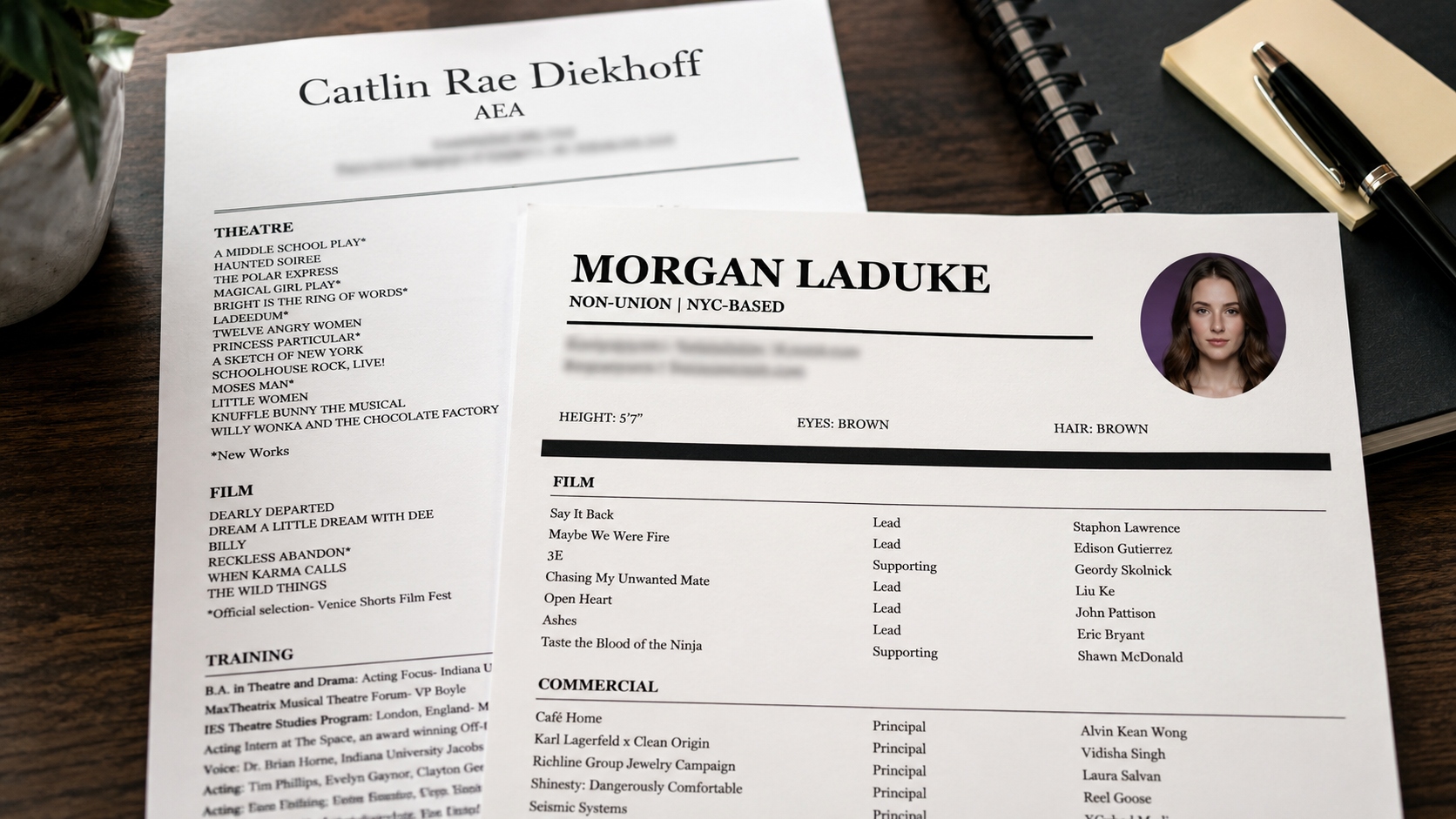
Resume Update: Industry Standards That Still Matter (and Why They Affect Your Submissions)
When we first published Formatting Your Acting Resume: How to Present Your Work Like a Pro, our goal was to help actors create resumes that looked clean, professional, and easy for industry professionals to read.
Unfortunately, we're still seeing one issue come up over and over again: actors are formatting credits using terminology that doesn't reflect industry standards.
While some people dismiss resume formatting as "just a matter of opinion," it really isn't. Your resume is one of the first things an agent, casting director, producer, or director sees. If the terminology is inaccurate, it can signal that the actor either hasn't been properly guided or doesn't yet understand how the industry classifies roles.
No one is going to refuse to cast you because you wrote "Supporting" instead of "Co-Star." But details matter. Your resume should demonstrate that you understand the business you're trying to work in.

The 30-Minute Weekly Review That Keeps Your Acting Career Moving
There is a big difference between wanting an acting career and actively building one.
A professional acting career requires regular attention beyond auditions and bookings. There are projects to research, relationships to build, submissions to make, materials to maintain, skills to develop, industry changes to follow, and results to track. If the only time you're actively working on your career is when an audition lands in your inbox—or when you suddenly feel motivated to "get back to it"—you're leaving far too much of your career to chance.
Ideally, some part of your acting business should get your attention every day. That doesn't mean spending hours on career development seven days a week. Some days you may have 20 or 30 minutes; other days you may have two hours. The important shift is treating career work as a regular part of being a professional actor rather than something you do occasionally when time allows.
For many actors, the problem isn't a lack of ambition. They genuinely don't know what to do every day. When there isn't an audition to prepare or an obvious deadline in front of them, career development can quickly become an overwhelming list of things they know they should be doing.
You shouldn't have to sit down every morning and ask, "What should I do for my career today?"
That's where a weekly review can make a tremendous difference.

How to Build Real Career Momentum Before the Fall Season
Last week, we looked at where the work is right now and why waiting until September to think about the fall season means you’re already behind.
Now comes the more important question:
What are you going to do with that information?
Knowing that a television series is in production doesn’t move your career forward.
Knowing that a theatre has announced its season doesn’t move your career forward.
Knowing that casting is picking up doesn’t move your career forward.
Taking action does.
August is your opportunity to turn what you know about the industry into a plan for where you want to be in it.
Not someday.
This fall.

🎬 The Actor Reel in 2026: Your Digital Handshake (and Booking Tool)
In today’s casting landscape, your reel isn’t optional—it’s essential.
Before a casting director reads your résumé…
Before they click through your website…
Before they even look at your headshot twice…
They press play.
Your reel is your digital handshake—a fast, visual introduction to your work, your type, and your booking potential. In many cases, it can be the deciding factor between pass and bring them in.
As we say at UTDA:
You are the CEO of YOU Inc.—and your reel is one of your most powerful marketing tools.

Before the Fall Rush: Where the Work Is Right Now in the Entertainment Industry
Every year around this time, I start hearing the same questions from actors.
"Is the industry finally picking back up?"
"Is August still slow?"
"Should I wait until September before I really start submitting?"
They're fair questions.
The entertainment industry has changed dramatically over the past few years, and many of the old "rules" actors relied on simply don't apply the way they once did.
The truth is that understanding where the work is happening has become just as important as being prepared when opportunities arise.
Today's industry isn't moving in one direction.
It's moving in many.
Actors who recognize those shifts can position themselves far more effectively than those relying on outdated assumptions.

Q3 Check-In: Did You Build Momentum or Press Pause?
Three months ago, we encouraged you to step back and conduct a Quarterly Career Review.
Not because your career can be measured in 90 days—but because 90 days is long enough to create meaningful progress and short enough to make adjustments before an entire year slips away.
Now that we've entered Q3, it's time to ask a different question:
Did you actually follow through?
This isn't about guilt or judging yourself. It's about understanding where momentum was created... and where it quietly stopped.
Let's take a look.

Why Your Email Signature Matters More Than You Think
The Simple Detail That Can Cost You Opportunities
Picture this:
A casting director has just finished reading through 75 actor submissions before lunch.
An agent is sorting through dozens of referral emails.
A producer wants to quickly pull your phone number to see if you're available next week.
They scroll to the bottom of your email...
Nothing.
No phone number. No website. No IMDb. No reel. No headshot. No Actors Access. No city. No representation. Sometimes not even a last name.
Now they have to search through your email, open your attachments, click back to your original submission, or hunt through old correspondence just to figure out how to contact you.
Most won't.
It isn't because they aren't interested. It's because they're busy.
One of the easiest ways to demonstrate professionalism is also one of the most overlooked: a complete, polished email signature.